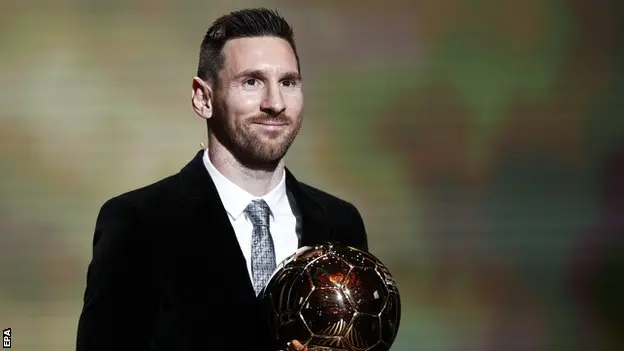
Organisers of the prestigious Ballon d’Or award have clarified that winning the FIFA World Cup is no longer a decisive factor in determining the recipient of football’s most coveted individual honour.
France Football, the body behind the award, made this known while revisiting the evolving criteria for selecting winners, particularly in light of the ongoing 2026 FIFA World Cup hosted across Canada, Mexico, and the United States.
Historically, World Cup success often played a significant role in Ballon d’Or decisions. Football legends such as Bobby Charlton, Paolo Rossi, and Lothar Matthäus all secured the award after lifting the World Cup.
Similarly, Zinedine Zidane (1998), Ronaldo Nazário (2002), and Fabio Cannavaro (2006) achieved the rare feat of winning both in the same year.
However, this pattern has shifted in recent decades.
In 2010, despite Spain’s World Cup triumph, Lionel Messi won the Ballon d’Or ahead of Spanish stars Andrés Iniesta and Xavi Hernández.
A similar trend followed in 2014 when Cristiano Ronaldo clinched the award even though Germany emerged World Cup champions, with goalkeeper Manuel Neuer finishing behind him.
Related News:
World Cup 2026: Broos Explains South Africa’s Exit After Canada Defeat
World Cup 2026: Nagelsmann Reveals Why Germany Crashed Out Against Paraguay
World Cup 2026: Canada, Paraguay, Morocco, Brazil Reach Round of 16
World Cup 2026: South Korea President Apologises After Group-Stage Exit
In 2018, Luka Modrić won the Ballon d’Or after leading Croatia to the World Cup final, despite not winning the tournament.
The World Cup-Ballon d’Or double only resurfaced recently when Lionel Messi guided Argentina to victory in 2022 and went on to claim the award in 2023.
According to France Football, only four out of seven World Cup-winning players since 1995 have also won the Ballon d’Or in the same year — a success rate of approximately 57 percent.
The organisers emphasised that while World Cup performance remains influential, it is no longer sufficient on its own.
“Winning the World Cup helps, but it does not guarantee the Ballon d’Or. To win, a player must be the best over the entire season, not just during the World Cup,” the statement noted.
This clarification reinforces a broader evaluation framework that considers consistency, overall performance, and individual excellence across all competitions throughout the football season.
About The Author