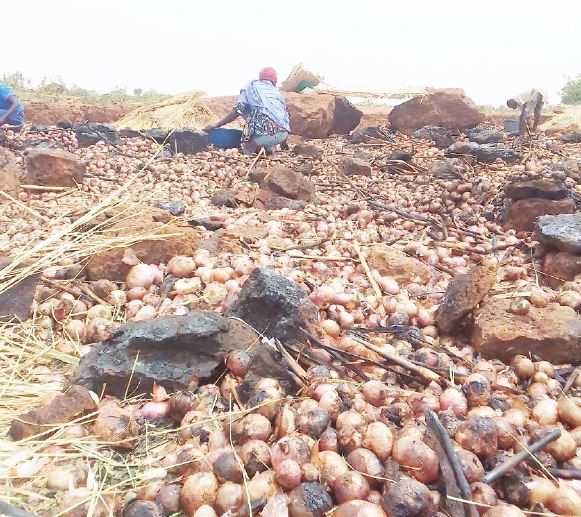
A devastating fire outbreak has destroyed 2,275 bags of onions in Kojiyo community, Goronyo Local Government Area of Sokoto State, leaving farmers counting losses estimated at ₦56.8 million.
The inferno, which reportedly started around 2 pm on Friday, engulfed about 65 traditional onion storage huts and burned for nearly seven hours before it was brought under control. Although no lives were lost, the incident has plunged the affected community into hardship and distress.
According to the National President of the Nigerian Onion Producers, Processors and Marketers Association of Nigeria, Aliyu Maitasamu, each storage hut contained an average of 35 bags of onions, valued at about ₦25,000 per bag.
He noted that while the cause of the fire is still under investigation, farmers had previously been warned about the risks associated with storing produce in huts made of dry materials, which are highly susceptible to fire outbreaks.
Despite the heavy losses, Maitasamu stated that the incident is unlikely to significantly affect onion prices in the market due to the relatively small quantity involved.
Related News:
Bandits Kill Two, Displace Residents in Sokoto Community
Troops Repel Late-Night Terrorist Attack in Sokoto Village
Gunmen attack Sokoto Community, abduct 5
However, affected farmers described the situation as catastrophic. Some victims said they lost their entire stock, which served as their primary source of livelihood and food security.
Community leaders have raised concerns over the growing hardship, with several households reportedly left without food or income.
They have called on the Sokoto State Emergency Management Agency and the National Emergency Management Agency to urgently intervene and provide relief support.
As of the time of reporting, the Sokoto State Emergency Management Agency said it had yet to receive an official report of the incident but assured that an assessment would be carried out once notified.
Residents fear the long-term impact on local supply if affected farmers are unable to recover in time for the next planting season.
About the Author