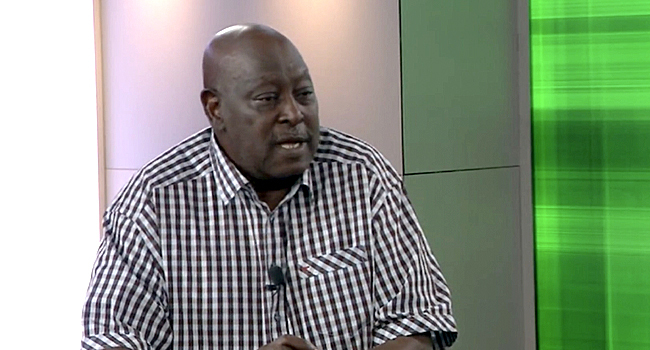
Former Secretary to the Government of the Federation, Babachir Lawal, has said he would nominate his 40-year-old son for a ministerial appointment if the presidential candidate of the Nigerian Democratic Congress, Peter Obi, offers him a position in his proposed administration.
Lawal, who served under former President Muhammadu Buhari, said he was no longer interested in holding public office, citing his age and claiming he had accomplished all he wanted in life.
Speaking on Channels Television’s Politics on Friday, the former SGF said he would prefer to return to his farm and watch the country develop rather than accept an appointment in an Obi-led government.
“Go back to my farm and watch Nigeria grow,” he said when asked what he would do if Obi emerged victorious in the 2027 presidential election.
Explaining his position, Lawal, 72, said he would rather recommend his son for the position of Minister of Agriculture if Obi offered him the opportunity.
“What is wrong if Peter says, ‘BD, give me, I’m going to make you Minister of Agriculture,’ and I say, ‘Peter, instead, give my son Minister of Agriculture’? Is that wrong?” he asked.
He argued that older politicians should make way for younger generations, adding that he considered himself an elder statesman who no longer needed government appointments.
“I’m 72, past 72. An elder statesman. And God has done well for me. I’ve achieved everything that I need to achieve,” he said.
Lawal also dismissed suggestions that he joined the NDC to secure a political appointment, insisting that his decision was motivated by his desire to support what he described as a credible candidate capable of addressing Nigeria’s challenges.
He expressed confidence that Obi would win the 2027 presidential election, arguing that the former Anambra State governor would perform better across the country than he did in 2023.
Revisiting the 2023 election, Lawal maintained that the contest should have proceeded to a runoff, claiming that Obi secured the highest number of votes but failed to meet the constitutional requirement for geographical spread.
“Peter got the majority of votes; he didn’t get the spread. Bola Tinubu got the spread and came second. There should have been a runoff in that election,” he said.
The former SGF predicted that Obi would secure victories in Kogi, Benue and Plateau states in 2027. He also claimed that former Vice-President Atiku Abubakar would finish third in his home state of Adamawa.
“Atiku will come third in Adamawa State this time around,” Lawal said.
Related News:
Nigeria’s Future Depends on Good Governance, Productive Economy – Peter Obi
Enugu Suspends Traditional Ruler Over Alleged High-Handedness, Denies Peter Obi Visit Link
He further questioned Atiku’s electoral prospects, arguing that the former vice-president would struggle to secure sufficient support across Nigeria’s ethnic and regional groups.
Comparing the NDC presidential ticket with those of rival parties, Lawal described the Obi-Kwankwaso combination as a stronger option for the country.
He also disclosed that the party intended to adopt town hall meetings as a major component of its campaign strategy, arguing that direct engagement with voters would be more effective.
According to Lawal, Obi’s perceived integrity, national outlook, business experience and consistency made him a suitable candidate for the presidency.
“First of all, he is incorruptible. Second, he is detribalised. Third, he is a businessman that understands market forces. And fourth, he is a man who sticks to his words,” he said.
Asked whether Obi had made any promises to him in return for his support, Lawal replied, “No, he doesn’t need to.”
Lawal joined the NDC in September 2026 after leaving the African Democratic Congress and subsequently declared his support for the Obi-Kwankwaso presidential ticket.
Obi, a former governor of Anambra State, is the NDC’s presidential candidate for the 2027 election, with former Kano State Governor Rabiu Kwankwaso as his running mate.
In the 2023 presidential election, Obi, who contested on the platform of the Labour Party, finished third with 6,101,533 votes, behind Atiku, who secured 6,984,520 votes, and President Bola Tinubu, who won with 8,794,726 votes.
About the Author