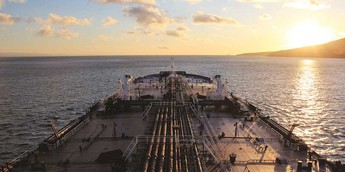
The United States Coast Guard, working alongside the U.S. Navy, has intercepted the Nigerian-owned supertanker Skipper over suspicions of crude oil theft, piracy, and other transnational criminal activities.
The 20-year-old Very Large Crude Carrier (VLCC), identified by IMO number 9304667, is said to be owned and operated by Nigeria-based Thomarose Global Ventures Ltd., although official records list its registered owner as Triton Navigation Corp., based in the Marshall Islands.
Authorities reported that the tanker was illegally flying the Guyanese flag at the time it was intercepted. However, in a swift response, Guyana’s Maritime Administration Department (MARAD) clarified that the Skipper is not listed on its national ship registry and had been using the country’s flag without authorization.
According to U.S. security officials, the operation was executed under American law enforcement authority, with President Donald Trump announcing the seizure.
Beyond allegations of crude oil theft, the vessel is also under investigation for reportedly transporting a significant shipment of hard drugs and operating within a network believed to be funded by suspected Iranian and other Islamist-linked money-laundering financiers.
A check with the Corporate Affairs Commission (CAC) in Abuja revealed that Thomarose is currently inactive. Further investigations by Vanguard showed that the company’s registered address is 111 Jakpa Road, Effurun, Warri, Delta State, with CAC registration number 1007876. However, no contact phone numbers are associated with the firm.
The President of the Centre for Marine Surveyors Nigeria, Engr. Akin Olaniyan, said the incident, if confirmed to involve a vessel that departed from Nigeria, exposes serious gaps in the country’s Port State Control system.
He explained that, “If the vessel actually left Nigeria, it suggests that our Port State Control is practically non-existent.
It also means ships departing Nigerian waters may be subjected to stricter scrutiny by Port State Control authorities in other countries.
This is not about Nigeria as a country, but about the quality of regulatory enforcement.
About the Author