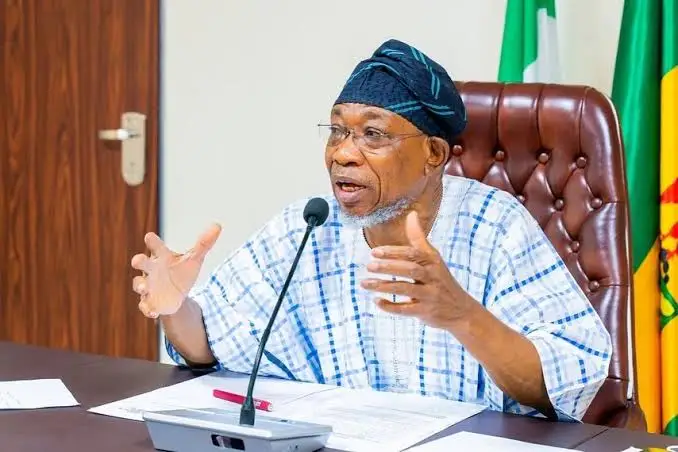
former, interior minister, Rauf Aregbesola
Former Interior Minister, Rauf Aregbesola, has called for urgent intervention from both government and society to address what he described as the growing neglect of the boy child in Nigeria.
He warned that the country’s future could be endangered if millions of young boys continue to grow up abandoned and without access to education.
Aregbesola made the call in Abuja during the maiden edition of the AfriCultural Fashion Show and Awards organised by the Global Awareness for Development Initiatives.
Speaking on the theme of empowering the African boy child, the former minister stressed that while advocacy for the girl child remains vital, the challenges facing boys who often carry heavy societal expectations with little emotional or economic support must not be overlooked.
According to him, society expects boys to grow into responsible men and leaders but often fails to provide the necessary support for their development.
“The boy child floats and sinks in a society that has largely failed him but expects him to be a good citizen, a patriot and a nationalist,” he said.
Aregbesola lamented that many boys, particularly from low-income families, are forced to assume responsibilities beyond their age, with some abandoning education to support their households.
The former governor of Osun State also pointed to Nigeria’s alarming number of out-of-school children, describing the situation as a serious threat to the nation’s future stability.
He noted that millions of boys are commonly seen on the streets hawking goods, begging for alms, or cleaning car windshields in traffic in order to survive.
Related News:
Tinubu okay N10b for FCT youths empowerment
Tinubu Submits FCT 2026 Budget Proposal to Senate for Approval.
N500M Allocated for Skills, Hairdressers, Make-Up Artists, Youth Development
Poverty Shapes Young Nigerian’s Determination to Succeed
“The more tragic part is that here in Nigeria, there are about twenty million of those kids out of school roaming our villages, towns and cities,” he added.
He warned that a society with a large population of uneducated and neglected youths risks producing adults who may turn to crime, drug abuse, or irregular migration as a way to escape hardship.
To address the challenge, Aregbesola urged Nigerians to hold governments accountable for providing free and quality education for all children, describing education as a critical social investment.
He advocated free education from the basic level to the pre-degree stage and called for university education to be made affordable for the average Nigerian.
Reflecting on his tenure as governor of Osun State, Aregbesola highlighted several initiatives implemented by his administration to improve access to education and empower young people.
These included free schooling, a school feeding programme for about 150,000 elementary pupils, distribution of school uniforms, and the construction of large modern school facilities capable of accommodating thousands of students.
He also referenced youth empowerment initiatives such as the Osun Youth Empowerment Scheme (O-YES), which created employment opportunities for unemployed youths.
In addition, he spoke about character-building programmes introduced in schools through clubs aimed at promoting discipline, courage, and integrity among students.
In his concluding remarks, Aregbesola cautioned Nigeria’s political and economic elites that the consequences of societal neglect would ultimately affect everyone.
“If the boy child in Nigeria has no future worthy to live in, no other citizen can hope for a better future,” he said.
He therefore called on Nigerians to work collectively toward building a society founded on social justice and humanism, stressing that securing the future of both boys and girls is essential for sustainable national development.
About the Author