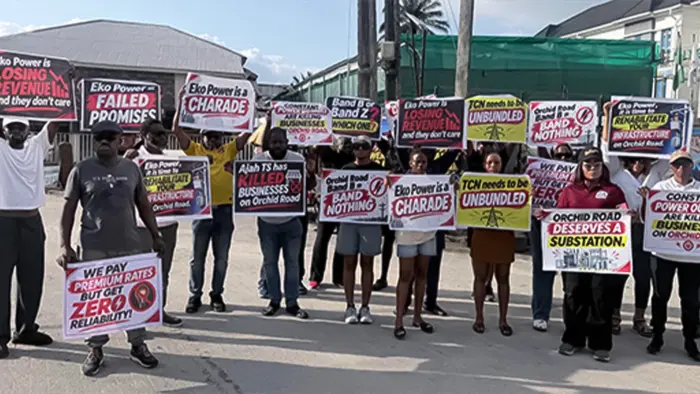
Residents of the Lekki Conservation Estates Community Development Area (LECECODA) have staged a protest over four months of erratic electricity supply along Orchid Road in Lagos State.
The residents, who staged the protest over the weekend, expressed frustration over prolonged power outages despite being classified under Band B, which attracts payment for a higher level of electricity service.
According to the community, customers connected to the Maroko 33kV feeder received only about 10 hours of electricity throughout October 2026.
Leading the protest, LECECODA President, Bode Akinwande, said repeated engagements with Eko Power, formerly known as Eko Electricity Distribution Company (EKEDC), had failed to produce any meaningful improvement.
He explained that the community had been engaging successive management teams of the electricity distribution company for about five years, with several promises made but none implemented.
Akinwande disclosed that the community formally wrote to Eko Power’s Acting Managing Director, Sherifat Adegbenro, on October 20, 2026, requesting a meeting and outlining its concerns, but had yet to receive a response.
He lamented that the poor electricity supply had severely affected businesses, residential estates and households, resulting in financial losses and increased dependence on alternative power sources.
The community also raised concerns over inadequate electricity distribution infrastructure, noting that Orchid Road, which accommodates about 200 residential estates alongside schools, shopping centres, restaurants and religious institutions, lacks a dedicated injection substation.
Related News:
Teenager Allegedly Sells Newborn Baby for N2m In Lagos
NAFDAC Uncovers Unregistered Cosmetics, Fake Drug Materials In Lagos
Fire Destroys Top Floor Of Residential Building In Lagos
Another resident, Olose Saheed, alleged that despite about 95 per cent of residents paying their electricity bills promptly, they continued to receive bills even when power was unavailable.
He further disclosed that the community was spending heavily on diesel, consuming approximately 800 litres daily to sustain electricity supply through alternative sources.
Similarly, another resident, Adeyinka Aderemi, called for government intervention, insisting that the community was willing to pay for reliable electricity but deserved better service.
The protesters called on Eko Power to restore electricity supply in line with the community’s Band B classification or adjust its billing to reflect the actual service delivered.
They also demanded a technical audit of the Maroko 33kV feeder and a clear timeline for resolving the persistent power supply challenges.
Additionally, the residents urged the Nigerian Electricity Regulatory Commission (NERC) to investigate the discrepancy between the community’s Band B classification and the electricity supply it receives.
They also called on the Transmission Company of Nigeria (TCN), Ajah, and Eko Power to clarify their respective responsibilities over the prolonged outages, accusing both organisations of shifting blame while residents bear the consequences.
The community warned that its patience had been exhausted, stressing that it would continue to pursue legitimate channels until reliable electricity supply was restored.
About the Author